




A CFO for small business brings order to this chaos by providing strategic financial guidance without breaking your budget. Think of them as your financial co-pilot – someone who helps steer the complex terrain of business growth while you focus on what you do best.
When basic bookkeeping no longer cuts it (trust me, there comes a point when it doesn’t), a fractional CFO fills the gap. They work with you part-time or on specific projects, delivering executive-level expertise that would otherwise cost you a full-time salary.
The numbers tell the story: with 99.9% of U.S. businesses classified as small and a sobering 20% closing their doors each year, the difference between just surviving and actually thriving often comes down to smart financial leadership.
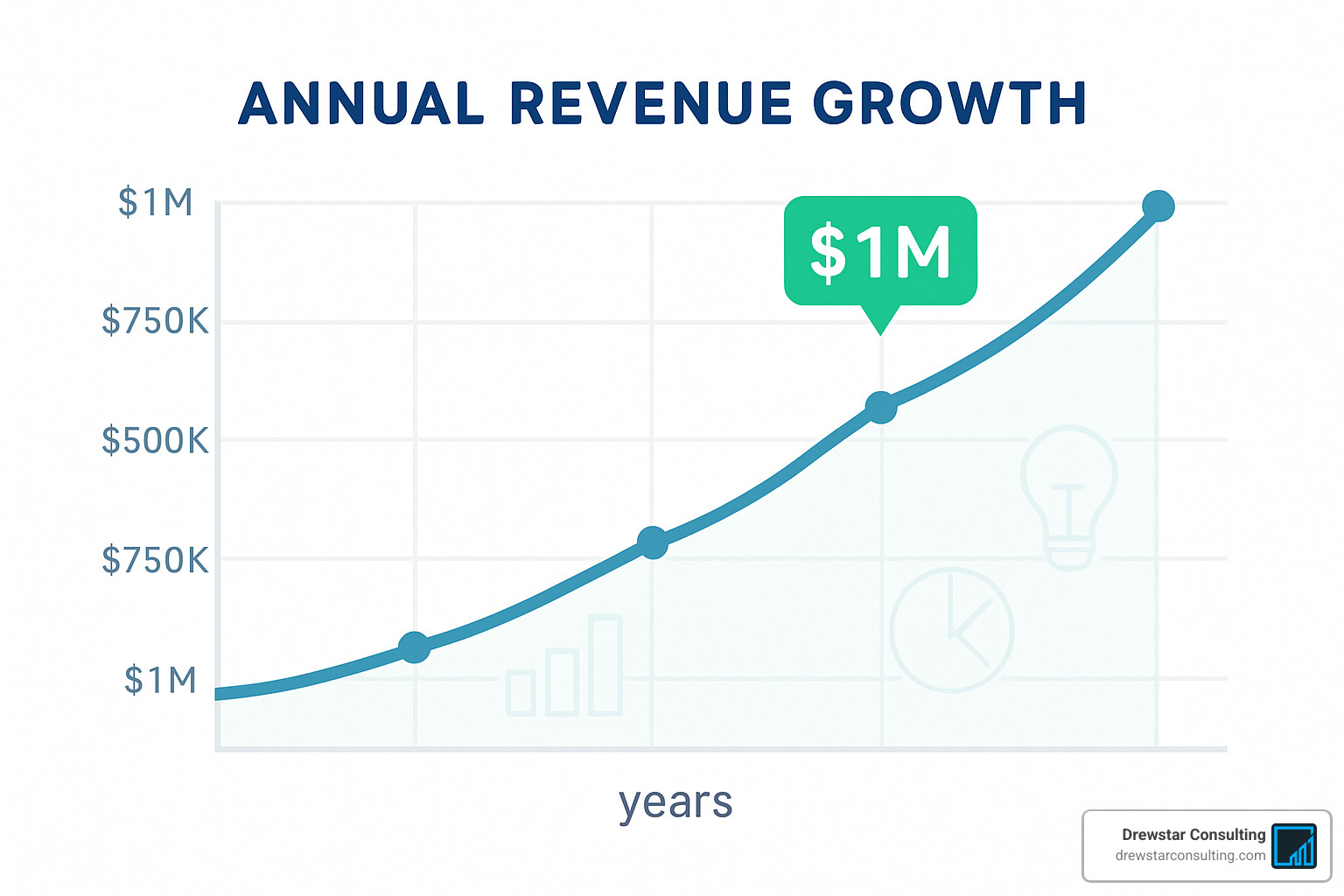
Most small business owners find they need this level of support when they hit around $1 million in revenue or when financial complexity increases. At this stage, the investment (typically $1,000-$12,000 monthly) delivers a significant return, saving about 60% compared to hiring full-time.
What makes a CFO different from your bookkeeper or accountant? While those roles focus on recording past transactions and ensuring compliance, a CFO for small business looks forward – helping you make strategic decisions based on solid financial data and forecasting. They transform financial challenges into growth opportunities.
Whether you’re struggling with unpredictable cash flow, preparing to raise capital, or implementing new financial systems, the right CFO partnership can be transformative. They bring clarity to your numbers and confidence to your decision-making.
What Does a CFO Do for a Small Business?
Think of a CFO for small business as your financial co-pilot—someone who helps steer your company toward growth while avoiding financial turbulence. Unlike the folks who handle your day-to-day books, a CFO brings strategic vision that shapes your company’s future.
The 2023 Small Business Profiles from the SBA reminds us that small businesses are truly America’s economic engine, making up 99.9% of all businesses and employing nearly half the workforce. Yet many of these businesses hit growth ceilings because they lack proper financial leadership.
Andrew Potts, a respected voice in small business finance, puts it perfectly: “The true role of a CFO is comprehensive financial leadership, not bookkeeping or operations.” This distinction matters tremendously for your bottom line.
Your CFO becomes the architect of your financial success through several crucial functions. They’ll develop strategic financial plans that translate your business vision into actionable budgets and forecasts. They’ll master your cash flow management, ensuring you never miss payroll or growth opportunities due to liquidity issues. They’ll implement risk mitigation strategies that protect what you’ve built, while optimizing your capital structure to fuel expansion.
When it comes to investor and lender relations, your CFO becomes your financial spokesperson, communicating your business story through numbers that inspire confidence. And through customized performance measurement dashboards, they’ll keep everyone focused on the metrics that truly drive success.
Core Responsibilities Every Owner Should Know
Understanding what your CFO for small business handles helps you maximize this vital relationship. Let’s explore the essentials:
Budgeting and Financial Planning goes far beyond basic spreadsheets. Your CFO creates living financial roadmaps aligned with your strategic goals. They’ll build annual operating budgets broken down monthly, plan capital expenditures thoughtfully, establish department accountability, and regularly compare actual results against projections—explaining variances and recommending course corrections.
Scenario Planning becomes your business safety net. In today’s unpredictable world, preparing for multiple possible futures isn’t optional—it’s essential. Your CFO will develop best-case, expected-case, and worst-case financial models, identify early warning signs that trigger contingency plans, and quantify the financial impact of major decisions before you commit.
Systems Selection and Implementation ensures your financial infrastructure grows with your business. Your CFO will evaluate appropriate financial software options, oversee smooth implementations, develop reporting frameworks that deliver actionable insights, and create controls that safeguard your assets.
With the right CFO partnership, these sophisticated financial capabilities become accessible without breaking your budget. You gain the clarity to make confident decisions and the financial structure to support sustainable growth—exactly when your business needs it most.
CFO vs. Bookkeeper, Accountant & Controller: Clear-Cut Differences
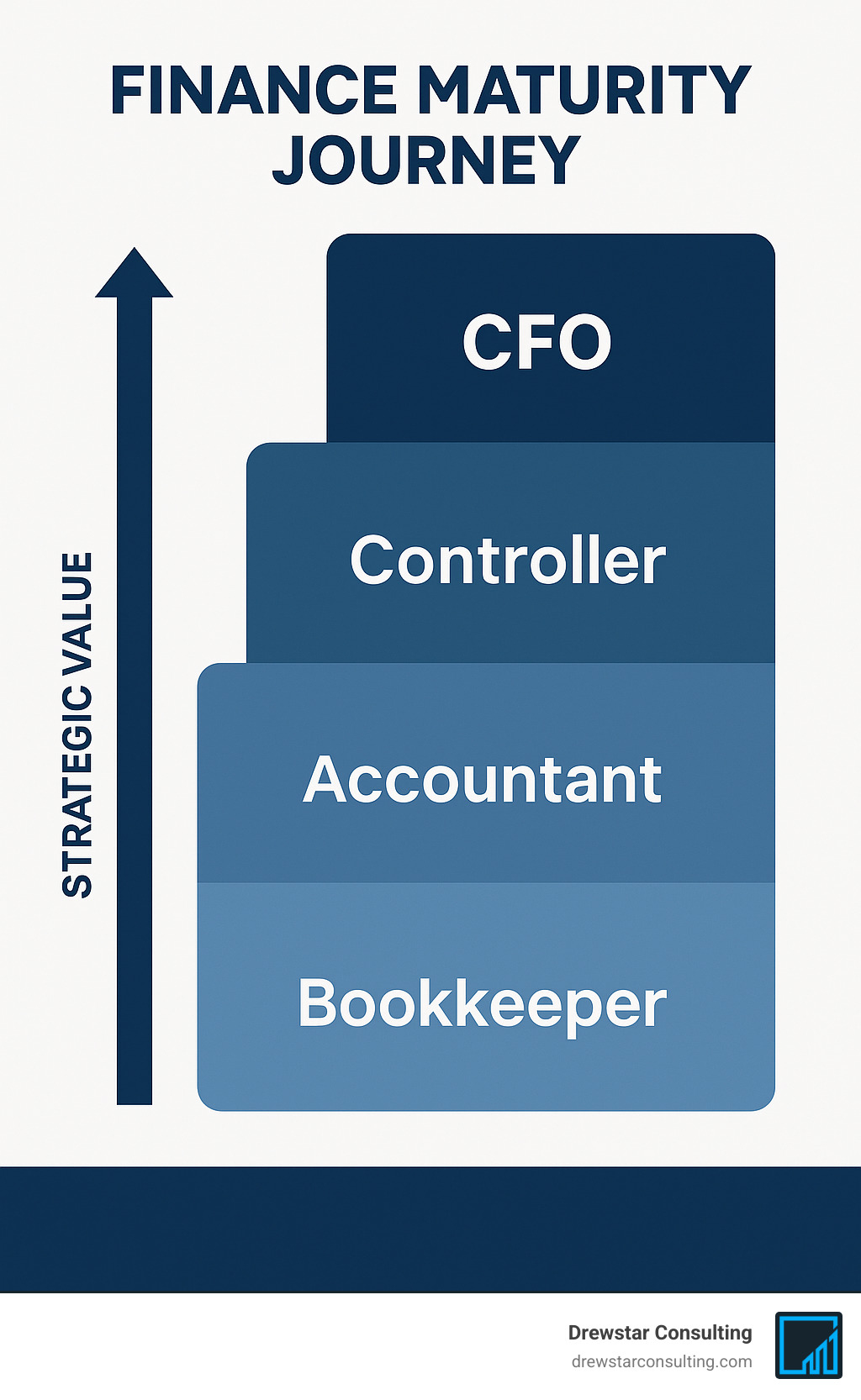
When I talk with small business owners, there’s often confusion about the different financial roles. Let me clear this up – think of your financial team like a house: bookkeepers lay the foundation, accountants build the structure, controllers ensure everything is up to code, and CFOs for small business design the blueprint for future expansions.
Here’s how these roles truly differ:
| Role | Primary Focus | Time Orientation | Strategic Input | Typical Cost Range |
|---|---|---|---|---|
| Bookkeeper | Transaction recording | Past | Minimal | $20-50/hour |
| Accountant | Financial statements & tax compliance | Past & present | Limited | $50-150/hour |
| Controller | Financial operations & reporting | Present | Moderate | $80,000-150,000/year |
| CFO | Strategic financial leadership | Future | Extensive | $150,000-300,000/year (full-time) or $1,000-12,000/month (fractional) |
Financial Reporting vs. Strategic Planning
While your bookkeeper diligently records transactions and your accountant prepares financial statements, your CFO for small business is looking at those numbers and asking, “What story do these tell about our future?” They’re not just reporting—they’re using that information to help you make smart growth decisions.
Compliance vs. Insight
Yes, your accountant ensures you’re following tax regulations and GAAP requirements. That’s essential! But as your Fractional CFO, I take this further by turning those compliance necessities into strategic advantages, and for example, understanding tax incentives that could fuel your growth strategy.
Internal Controls
The difference in approach to controls is striking. Your bookkeeper follows the procedures you’ve established. Your controller implements systems to ensure accuracy. But your CFO for small business designs frameworks that balance protection with progress—ensuring you’re secure without creating bureaucracy that slows your company down.
Delegation Levels
As you move up the financial hierarchy, you’ll notice the scope broadens significantly. Bookkeepers execute specific tasks, accountants manage processes, controllers oversee departments, and CFOs provide leadership that spans multiple business functions, often serving as a trusted right hand to the owner.
Why a CFO Brings More Than “Keeping the Books”
When you’re ready to move beyond just “keeping score” with your finances, a CFO for small business delivers value in ways that transform your company’s trajectory.
Value Creation
This is where CFOs truly shine. While your accounting team ensures accuracy, your CFO actively hunts for profit opportunities. One of our Fort Lauderdale retail clients saw this firsthand—their margins jumped 15% after our fractional CFO analyzed profitability by product line and customer segment.
Your CFO will help you answer critical questions: Which products actually make money? Which customers cost more than they’re worth? Where should you invest next? These insights directly impact your bottom line.
Decision Support
Business decisions are only as good as the information behind them. Your CFO becomes your trusted advisor, bringing data-driven insights to the table when you’re facing pivotal choices about growth investments, market expansion, or acquisition opportunities.
One West Palm Beach business owner described having a CFO at the table when we were considering an acquisition as invaluable. Their financial due diligence uncovered issues we would have missed and saved us from a costly mistake.
Audit Readiness
If you’re seeking investment or preparing for a future sale, audit-ready financials aren’t just nice to have—they’re essential. Your CFO for small business builds processes that stand up to scrutiny, ensures documentation meets professional standards, and addresses potential issues before external reviewers find them.
When & Why to Hire a CFO — Triggers, Milestones & ROI
Is your business at that critical turning point where financial expertise could make or break your future? Many small business owners struggle with knowing exactly when it’s time to bring in a CFO for small business support.
While there’s no magic formula that works for every company, certain milestones tend to signal it’s time for more sophisticated financial leadership. Most financial experts suggest considering fractional CFO services once you hit $1 million in annual revenue, while full-time, in-house CFO support typically makes sense in the $5-15 million range.
But revenue is just one piece of the puzzle. The complexity of your business often matters more than its size. Are you expanding to multiple locations? Launching new products or services? Significantly growing your team? Planning for a business exit in the next few years? These growth-stage indicators often trigger the need for CFO-level thinking.
External pressures can also push you toward this decision. If you’re preparing to seek outside investment, significant debt financing, or managing relationships with multiple capital providers, a CFO becomes almost essential.
Risk factors play a role too. Companies in highly regulated industries, those managing complex contractual obligations, dealing with intricate tax situations, or navigating international operations benefit tremendously from CFO expertise. A CFO for small business helps you not just comply with requirements but turn them into strategic advantages.
Signs You Need a CFO for Small Business
Beyond the obvious milestones, certain warning signs might be flashing in your business right now. Here are eight red flags that suggest your company has outgrown its current financial leadership:
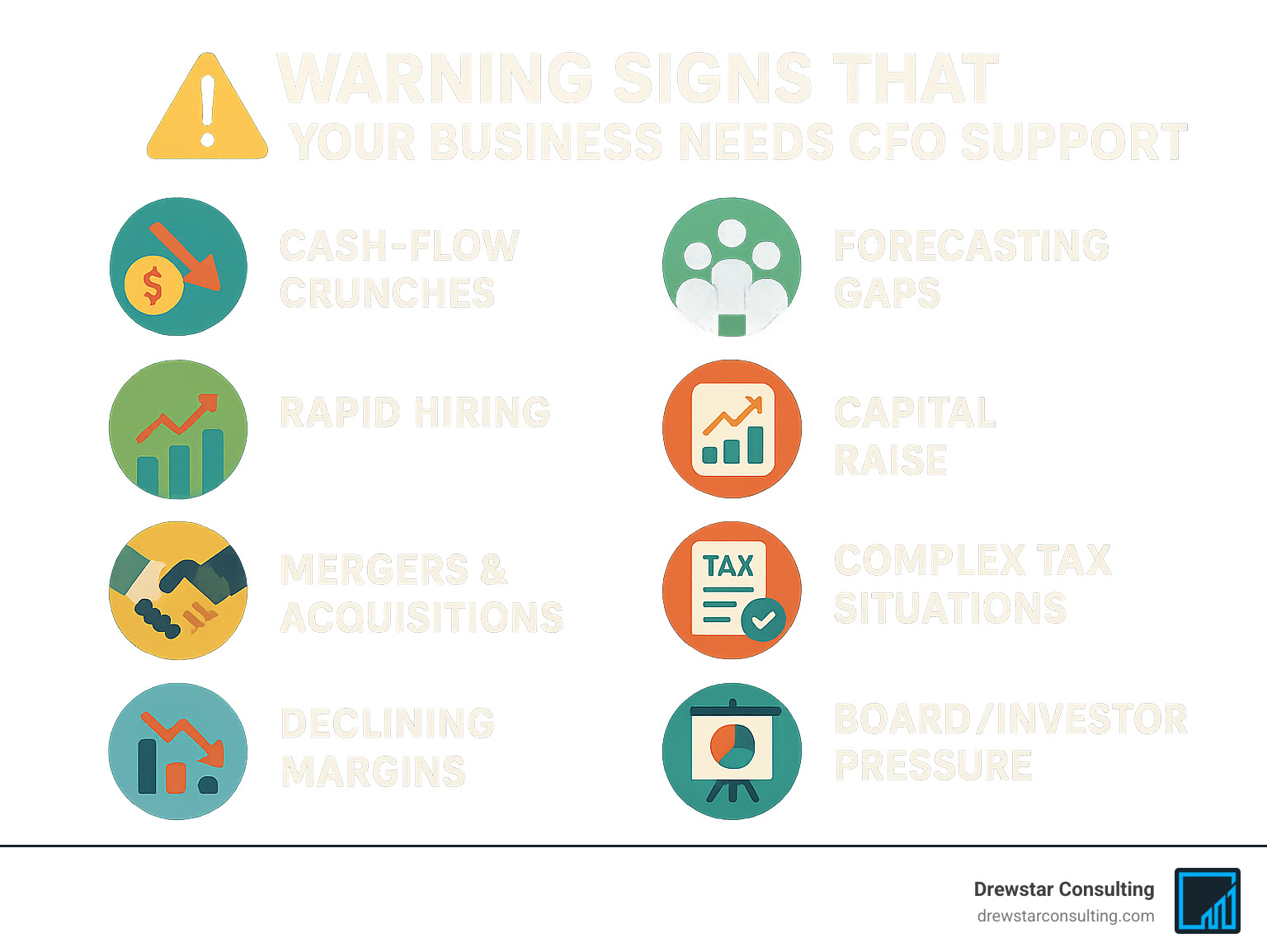
That frustrating cash-flow crunch despite showing profits on paper? It’s incredibly common. A Cape Coral construction company I worked with was technically profitable but constantly scrambling to make payroll until we implemented a 13-week cash flow model that transformed their operations. The difference between accounting profit and actual cash availability is where many small businesses struggle.
If you can’t confidently predict your financial position a few months out, you’re experiencing forecasting gaps that can derail your decision-making. One of my clients, a restaurant group in Naples, struggled with this until we developed a sophisticated forecasting model that accounted for tourism patterns and seasonal fluctuations. Suddenly, they could staff appropriately and manage inventory with confidence.
When preparing for capital raises, the sophistication of your financial presentations matters tremendously.
When you see declining margins despite revenue growth, something’s clearly wrong. A retailer in Plantation was expanding rapidly but seeing shrinking profits until their CFO conducted a comprehensive margin analysis by product line and location. The insights helped them refocus on their most profitable segments.
Choosing the Right CFO for Small Business
Once you’ve determined you need CFO support, the next question is what type of arrangement makes sense for your unique situation.
Some companies can’t justify a full-time CFO, but the fractional model gave us access to the same expertise at a price point that worked for us. This flexible approach allows businesses to scale financial leadership as they grow.
Cultural match matters tremendously in any executive relationship. The right CFO should align with your company’s values and communication style. Consider their industry experience, communication approach (technical versus simplified), decision-making philosophy, and growth mindset alignment.
Engagement scope should be clearly defined from the start. What exactly do you need? Strategic guidance only? Hands-on implementation? Team development and mentoring? Or perhaps a specific project focus like fundraising or systems implementation?
That makes Drewstar Consulting different: we work with Southern Florida businesses to determine the right engagement model based on their unique needs and growth stage. Our clients appreciate the flexibility to scale services up or down as their requirements evolve.
Avoiding Common Hiring Pitfalls
When bringing on a CFO for small business, several common mistakes can undermine the relationship from the start.
Unclear scope and expectations top the list. Be sure to define specific deliverables and timelines, establish clear reporting relationships, set measurable success metrics, and document the engagement parameters.
Technology misalignment can also create friction. Ensure your CFO has experience with your financial systems, discuss technology roadmap and improvement plans, confirm data security protocols, and evaluate their comfort with relevant analytical tools.
Cultural misfit issues often emerge only after the engagement begins. Involve key team members in the selection process, consider communication style and frequency, assess how they handle conflict, and evaluate their approach to change management.
Frequently Asked Questions about Small-Business CFOs
How much does a CFO for a small business cost?
When business owners ask about bringing on a CFO for small business, cost is usually their first concern. The investment varies significantly depending on how you structure the relationship:
For a traditional full-time CFO, expect to invest between $150,000-$300,000+ in annual salary alone. Don’t forget to add another 20-30% for benefits, potential bonuses, and possibly equity compensation. All told, you’re looking at $180,000-$390,000+ annually – a substantial commitment for most small businesses.
That’s why the fractional model has become increasingly popular among Southern Florida businesses. With monthly retainers ranging from $1,000-$12,000 depending on your needs and scope, you can access the same executive-level expertise for a fraction of the cost. For project-based work, hourly rates typically fall between $250-$400.
At Drewstar Consulting, we pride ourselves on transparent pricing and flexible engagement options. We structure our services to deliver maximum value at predictable costs that grow alongside your business.
At what revenue or complexity should I engage a CFO?
While many business owners focus on revenue thresholds, the truth is that business complexity often matters more when timing your CFO engagement.
From a pure revenue perspective, these guidelines generally apply:
- $1M+ annual revenue: This is when fractional or outsourced CFO services start making sense
- $5M-15M: Time to evaluate transitioning to a full-time CFO
- $15M+: A dedicated, full-time CFO is typically justified
However, complexity factors often trigger the need for CFO services earlier than these revenue milestones suggest. If your business has multiple locations, diverse revenue streams, a complex capital structure, or is growing at 30%+ annually, you might need CFO support sooner. The same applies if you face significant regulatory compliance requirements or have international operations.
The right timing ultimately depends on your specific situation and growth objectives – something we take time to understand during our initial consultations.
Can I start with project-based or part-time CFO support?
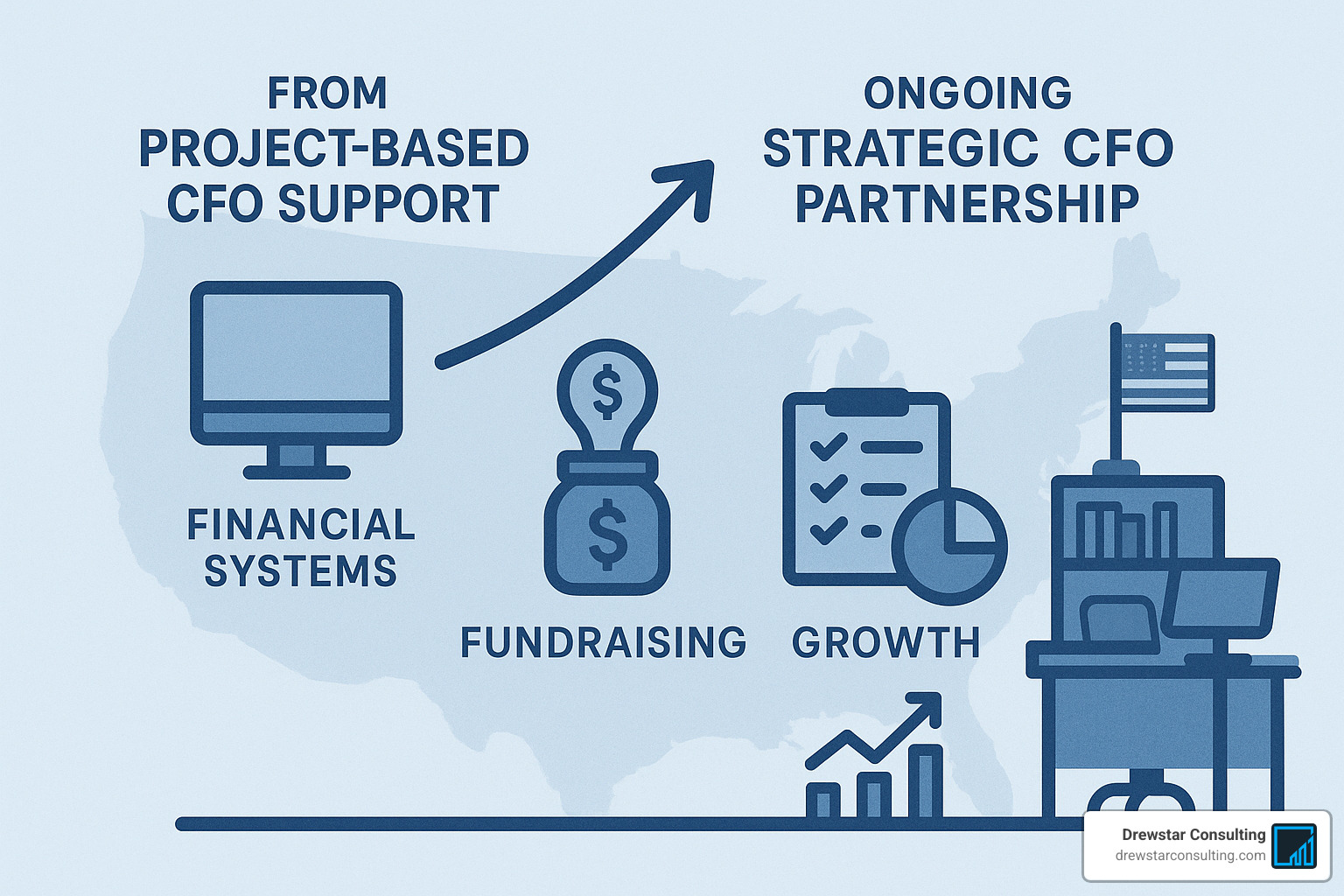
Many of Drewstar’s most successful client relationships began with targeted projects before expanding to ongoing support.
Many businesses test the waters with focused CFO engagements such as:
- Financial systems implementation (typically taking 2-3 months)
- Fundraising preparation and support (usually spanning 3-6 months)
- Annual budget development and forecasting (requiring 1-2 months each year)
- Cash flow optimization initiatives (generally 2-3 months)
- Acquisition due diligence (timeframe varies by deal complexity)
Starting with a defined project gives you a chance to establish the relationship, see concrete results, and evaluate the CFO’s impact against specific metrics. From there, you can gradually increase the scope as you see value, adjusting the engagement level as your business evolves.
This flexible approach minimizes your risk while maximizing the value you receive – something we’ve found resonates with business owners across Southern Florida who want to be prudent with their resources while still accessing the financial leadership they need.
Taking that Crucial Step
Ever wonder what separates thriving small businesses from those that struggle? Often, it’s not just hard work or a great product—it’s smart financial leadership. A CFO for small business is that missing piece for many growing companies, turning financial challenges into stepping stones for growth.
Throughout this guide, we’ve seen how CFOs do much more than crunch numbers. They’re strategic partners who help map your company’s future, spotting opportunities and steering clear of pitfalls before they become problems.
For businesses across Southern Florida—from the beaches of Fort Myers to the busy streets of Miami—financial leadership can make all the difference. At Drewstar Consulting, we understand the unique challenges of our local business environment. Our clients appreciate having a financial partner who speaks their language and understands their specific regional challenges.
Whether you’re wrestling with unpredictable cash flow, preparing for a growth phase, or simply wanting to sleep better at night knowing your finances are in capable hands, the right CFO relationship can transform your business outlook. And the best part? With fractional services, you don’t need a million-dollar budget to access this level of expertise.
Ready to explore how CFO services could benefit your growing company? Drewstar Consulting offers custom financial leadership solutions custom to your specific needs and growth stage. Learn more about our Fractional CFO services designed specifically for Southern Florida businesses.
With the right financial leadership by your side, your business won’t just survive the challenges ahead—it will thrive through them. Because when your finances are in order, you can focus on what you do best: running and growing your business.