



Ever wondered why some businesses thrive while others struggle to keep the lights on? The difference often comes down to one thing: solid business plan financials.
Think of your financial plan as the GPS for your business journey. Without it, you’re essentially driving blindfolded, hoping you’ll somehow reach your destination. Your business plan financials are the roadmap that shows not just where you want to go, but exactly how you’ll get there.
At their core, business plan financials tell your business’s money story through numbers. They demonstrate to investors, lenders, and even yourself that you’ve mapped out a realistic path to profitability. This isn’t just number-crunching—it’s strategic storytelling with data.
The harsh reality? About 90% of startups fail annually, with 29% running out of cash and 42% finding there’s no market for their product. A solid financial runway can mean the difference between becoming a success story or another statistic. Only half of small businesses celebrate their fifth birthday, and just a third make it to year ten.
As Warren Buffet wisely notes, strong financials create “economic moats“—competitive advantages he considers crucial when deciding where to invest. These moats don’t just attract investment; they protect your business from market turbulence and competition.
“If your business plan is the blueprint of how to run your company, the financials section is the key to making it happen.” – U.S. Chamber of Commerce
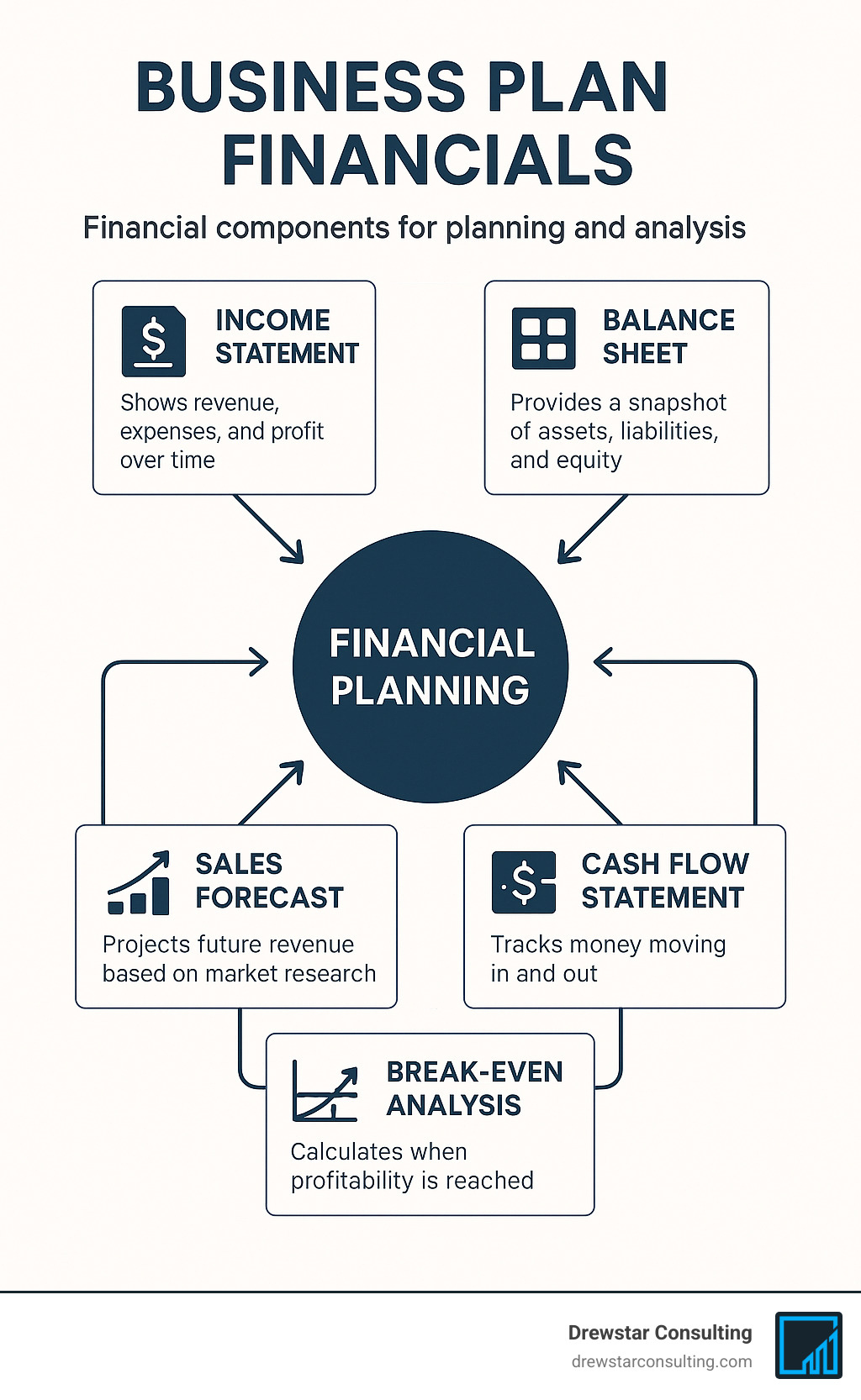
Your comprehensive business plan financials typically include five essential components:
Income Statement shows your profit story by tracking revenue, expenses, and bottom-line results over time. This reveals whether your core business model works.
Balance Sheet provides a financial health snapshot, detailing your assets, liabilities, and equity—essentially what you own versus what you owe.
Cash Flow Statement tracks the actual money moving in and out of your business, ensuring you can meet obligations even during growth phases.
Sales Forecast projects future revenue based on market research, giving credibility to your growth story and helping with resource planning.
Break-Even Analysis pinpoints exactly when your business will start generating profit—a critical milestone for any business owner or investor.
A thoughtfully prepared business plan with robust financials is essential for entrepreneurial success. Many investor groups won’t consider meeting without seeing your financial plan first.
Whether you’re seeking funding or simply planning for sustainable growth, your business plan financials provide the decision-making framework that transforms good ideas into successful businesses.
What Are Business Plan Financials & Why They Matter
Business plan financials are the heartbeat of your business plan – they transform your big ideas and strategies into concrete numbers that tell your company’s money story. These financial sections reveal where you’ve been, where you stand now, and where you’re headed financially.
I’ve seen too many brilliant entrepreneurs with game-changing ideas fall short simply because they didn’t have their financial house in order. The harsh reality? Your cash runway – how long your business can operate before running out of money – often determines your survival. It’s sobering that 29% of startups close their doors not because their product failed, but because they simply ran out of cash.
Your business plan financials serve as your business’s lifeline in several crucial ways:
First, they build investor confidence. When you’re seeking funding, investors aren’t just buying into your idea – they’re looking for return on investment. Venture capitalists typically want to cash out within three to seven years, expecting returns of 35-40% for established companies and up to 60% for newer ventures. Your financial projections need to show them a path to this profitability.
Second, these financials become your decision-making compass. When you’re facing tough choices about whether to hire that new employee, expand to a second location, or cut certain expenses, your financial plan provides the data that guides these decisions with clarity rather than guesswork.
Your business plan financials also map out your exit strategy. Whether your ultimate goal is selling the business for a substantial profit or creating a legacy that supports your family for generations, these numbers chart the course to your desired destination.
Perhaps most importantly, solid financials build credibility. As one successful entrepreneur told me recently, “You can have the most beautiful slide deck in the world, but without numbers that add up, nobody takes you seriously.” Your financial projections demonstrate that you’ve done your homework and understand what it takes to succeed.
Drewstar has worked with countless business owners in Southern Florida with brilliant concepts but fuzzy finances. The difference between those who thrived and those who struggled often came down to having a clear financial roadmap. Your business plan financials aren’t just paperwork to satisfy a bank—they’re the blueprint for building a sustainable, profitable business that can weather economic storms.
The Essential Components of Business Plan Financials
Income Statement: Your Profit Story
Think of your income statement (sometimes called a P&L) as the storyline of how your hard work transforms into profit. It’s like watching a movie of your business performance over time.
Your revenue streams form the beginning of this story—every dollar your business earns. For a local coffee shop, this might mean separating latte sales from pastries and merchandise. Then come the expenses: Cost of Goods Sold (COGS) covers direct costs like coffee beans and barista wages, while operating expenses include rent, utilities, and marketing costs.
The happy ending (hopefully!) is your net margin—the percentage of revenue that becomes actual profit after everything’s paid. I always tell my clients: “This isn’t just paperwork; it’s the story of your business success in numbers.”
Pro Tip: While annual statements are required for taxes, startups seeking funding should prepare monthly projections for year one, quarterly for years 2-3, and annually for years 4-5. This shows investors you’ve thought through the journey ahead.
Balance Sheet: Snapshot of Health
If your income statement is a movie, your balance sheet is the perfect still photograph—capturing your financial position at a specific moment in time. It’s built on a simple but powerful equation: Assets = Liabilities + Equity.
Your assets include everything the business owns—from the cash in your account and inventory on your shelves to the building you might own and the intellectual property you’ve developed. Your liabilities cover everything you owe, from tomorrow’s supplier payment to the 10-year business loan you’re paying off. The difference—your equity—represents your stake in the business.
The balance sheet isn’t just for accountants—it’s a powerful tool that shows your business’s solvency and working capital, metrics that lenders scrutinize when considering your loan application.
Cash Flow Statement: Oxygen of the Business
As we say in Florida, “You can swim in revenue but drown in cash flow.” Your cash flow statement tracks the actual money moving in and out of your business, and it’s truly the oxygen that keeps your business breathing.
The statement organizes cash movements into three categories: operating activities (your day-to-day business), investing activities (purchasing equipment or property), and financing activities (loans or investor funds).
Creating this statement is straightforward—start with last month’s balance, add cash coming in, subtract cash going out, and you’ve got your new balance. But the insights it provides are invaluable.
I’ve seen this with clients like a local construction company that was profitable on paper but struggling to make payroll because clients weren’t paying invoices for 60-90 days. Their cash flow statement highlighted this gap and helped us develop a solution that saved their business.
Sales Forecast & Revenue Modeling
Your sales forecast is where your business dreams meet reality—it’s the translation of your market research and strategy into expected dollars and cents. This is often the section investors flip to first in your business plan financials, as it drives everything else.
You can approach forecasting from two directions. Bottom-up forecasting starts with the specifics—like projecting 50 customers per day at your new Estero restaurant, with an average check of $25. Multiply that out, and you’re looking at $37,500 in monthly revenue.
Top-down forecasting starts with the big picture—if the local coffee market is worth $10 million annually and your research suggests you can capture 5%, you’re projecting $500,000 in revenue.
Pricing Analysis & Pricing Strategy: Increased Profits
Break-Even Analysis & Unit Economics
“When will I start making money?” It’s the question every business owner asks, and your break-even analysis answers it by identifying the point where total revenue equals total expenses.
The formula is straightforward: Break-even point = Fixed Costs ÷ Contribution Margin per Unit. For a coffee shop with $5,000 in monthly fixed costs and a $2 contribution margin per coffee ($3 selling price minus $1 variable cost), that’s 2,500 coffees needed monthly to break even.
Understanding your unit economics—the revenues and costs associated with each unit of your product or service—is crucial for scaling profitably. It helps you distinguish between fixed costs (like rent) and variable costs (like ingredients), calculate your contribution margin (how much each sale contributes to covering fixed costs), and determine your safety margin (how far sales can drop before you’re in the red).
Scientific research on break-even analysis
Building Realistic Forecasts: Step-by-Step
Let’s face it nobody has a crystal ball when it comes to financial forecasting. But that doesn’t mean we can’t create thoughtful, defensible projections that help you make better decisions and secure the funding your business needs to thrive.
At Drewstar Consulting, we’ve helped countless Southern Florida businesses build realistic business plan financials that stand up to scrutiny. Here’s our approach:
Start with what you know. If you have historical data, that’s gold! Past performance often gives us the best clues about future results. For new businesses, we dig into industry benchmarks and look at comparable companies to establish a baseline.
Next, identify what truly drives your business. Every company has key metrics that make or break their success. For a hotel, it might be occupancy rate and average daily rate. For a SaaS business, it’s typically customer acquisition cost and churn rate. These aren’t just random numbers they’re the heartbeat of your financial story.
Once we’ve identified these drivers, we connect them directly to your financial projections. This creates what we call driver-based models. For example, if you project 10% more customers and your average order value is $100, your revenue should increase by $100 multiplied by your current customer count, then multiplied by 10%. This approach makes your forecasts both defensible and actionable.
I always remind my clients that the future rarely unfolds exactly as planned. That’s why we create multiple scenarios a best case (optimistic but possible), a base case (most likely outcome), and a worst case (challenging but survivable). This approach helps you prepare for different possibilities rather than betting everything on a single prediction.
Finally, we test which variables most impact your bottom line through sensitivity analysis. I remember working with a local Naples restaurant where we found something fascinating a 5% increase in table turnover had more impact on profitability than a 10% increase in menu prices. This insight completely changed their operational focus!
The Power of Financial Models: A Key Asset for Business Leaders
Comparing Spreadsheets vs. FP&A Software for Financial Forecasting
| Feature | Spreadsheets | FP&A Software |
|---|---|---|
| Cost | Low (Excel license) | Moderate to high subscription |
| Learning curve | Moderate | Steep initially, easier long-term |
| Collaboration | Limited | Built-in, real-time |
| Error risk | High | Low (built-in validation) |
| Scenario planning | Manual | Automated |
| Integration with data sources | Manual | Automated |
| Time to create/update | High | Low after initial setup |
| Best for | Early-stage, simple models | Growth-stage, complex models |
While many of our clients start with spreadsheets (and there’s nothing wrong with that!), we’ve seen businesses reach a tipping point where dedicated financial planning software becomes worth the investment. The right choice depends on your business complexity, team size, and growth trajectory something we’re always happy to discuss over a cup of coffee here in Estero.
Stress-Testing & Risk Planning
Let’s face it—even the best business plans encounter unexpected challenges. That’s why stress-testing your business plan financials isn’t just smart planning; it’s essential survival strategy. Think of it as installing seatbelts before you need them, not after the crash.
Scenario Planning
When we work with clients across Southern Florida, we always develop three distinct scenarios to prepare for various futures:
Best Case: What happens if things go even better than expected? Maybe your new product catches fire on social media, or your customer acquisition costs drop dramatically. While this sounds great, rapid growth without preparation can be just as dangerous as decline.
Base Case: This is your most likely outcome—the scenario you’d bet on if forced to choose. It’s built on reasonable, defensible assumptions about your market, costs, and growth trajectory.
Worst Case: What if your primary supplier doubles their prices? What if a hurricane disrupts operations for two weeks? Or what happens if sales come in 30% below projections? These aren’t fun to think about, but they’re crucial conversations.
Contingency Planning
Once you’ve identified potential risks, the next step is developing specific strategies to address them:
Cash Reserves are your first line of defense. While conventional wisdom suggests 3-6 months of operating expenses, we often recommend our Florida clients maintain larger reserves—sometimes 9-12 months worth. Why? Our seasonal economy and hurricane vulnerability create additional risk factors that businesses in other regions don’t face.
Credit Lines should be established when your business is thriving, not when you’re desperate. As I often tell clients, “Try getting an umbrella when it’s already pouring rain.” Banks are much more generous with healthy businesses than struggling ones.
Insurance Coverage goes beyond basic liability. Business interruption insurance is particularly crucial in our hurricane-prone region. I’ve seen too many businesses struggle to recover after storms because they lacked proper coverage.
Regulatory Compliance Reserves are often overlooked but increasingly important. Setting aside funds for potential regulatory changes—especially in industries like healthcare, food service, or financial services—can prevent scrambling when new rules are implemented.
The statistics are sobering—nearly 29% of startups fail because they run out of cash. But here’s the insight many miss: this isn’t just about revenue. It’s about timing. Your business plan financials need to account for the rhythm of cash flowing in and out, not just the total amounts.
The goal isn’t perfect prediction—that’s impossible. The goal is ensuring your business has the flexibility to steer both storms and unexpected opportunities. As we like to say at Drewstar Consulting, “Plan for the worst, position for the best, and you’ll likely land somewhere in between—prepared either way.”
Presenting Your Numbers to Stakeholders
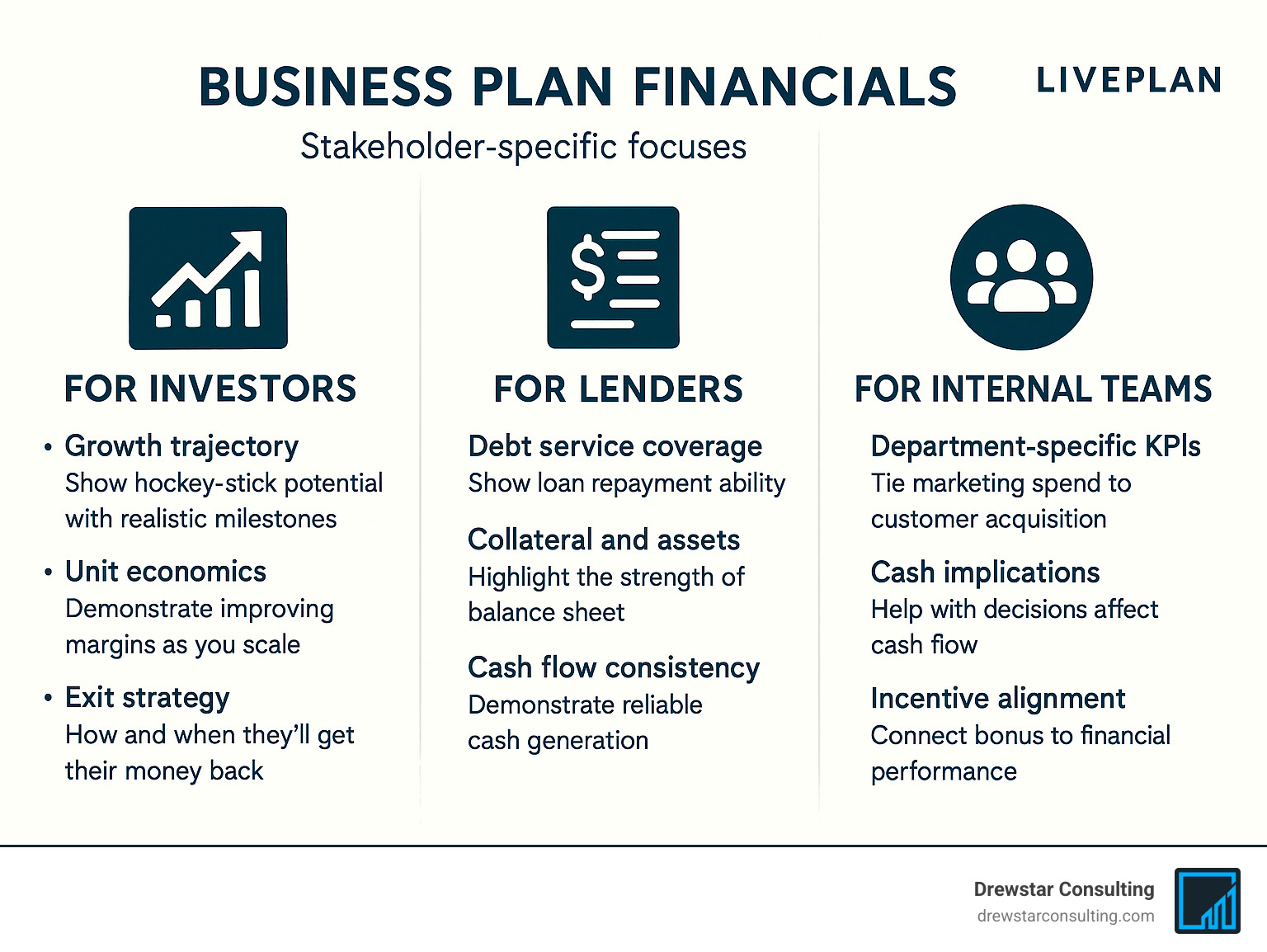
For Investors
When you’re pitching to venture capitalists or angel investors, remember they’re looking for a clear path to a substantial return. Most VC firms want to cash out within three to seven years, expecting returns of 35-40% for established companies and up to 60% for early-stage ventures.
What really captures their attention? Growth trajectory that shows realistic but exciting potential. Your unit economics need to demonstrate improving margins as you scale – investors want to see that you’ll become more profitable, not less, as you grow. And don’t forget a clear exit strategy that answers their most pressing question: “How and when will I get my money back with a healthy return?”
I always encourage clients to use visuals that highlight key metrics without overwhelming. As Harvard Business Review points out, “Flashy PowerPoint slides aren’t enough,” but thoughtful visualizations can transform complex data into an accessible financial story that investors can get excited about.
For Lenders
Banks and traditional lenders have a completely different mindset than venture capitalists. They’re not looking for the next unicorn – they want stability and confidence you’ll repay your loan.
When we helped a Miami restaurant secure expansion financing, we didn’t focus on their growth potential. Instead, we highlighted their consistent 3.2x debt service coverage ratio and five-year history of positive cash flow. This approach secured them a $350,000 loan with favorable terms because we spoke the language bankers understand.
With lenders, emphasize the strength of your balance sheet, your collateral and assets, and most importantly, your cash flow consistency. These elements demonstrate you’re a safe bet, which is exactly what traditional lenders want to hear.
For Internal Teams
Your team doesn’t need to understand complex financial models, but they do need to see how their work connects to the company’s financial health. I’ve found that sharing department-specific KPIs helps everyone understand their impact.
For example, show your marketing team how their spending affects customer acquisition costs, or help your production team understand how efficiency improvements directly boost margins. Always explain the cash implications of different decisions – in business, cash truly is oxygen.
One of my favorite approaches is connecting bonus structures directly to financial performance metrics that teams can influence. When people see how their daily work affects the bottom line (and their bonus), financial goals become much more tangible.
Presentation Best Practices
No matter who you’re presenting to, certain principles always apply. Start with the big picture before diving into details – context matters tremendously when discussing finances. Use consistent formatting throughout your documents to maintain professionalism and clarity.
Be transparent about what drives your numbers by highlighting assumptions. I always tell clients that stakeholders are more forgiving of projections that don’t materialize if they understood the underlying assumptions from the beginning.
Perhaps most importantly, tell a story with your numbers. Connect financial data to your business narrative in a way that feels cohesive and purposeful. And always, always be prepared for questions – know your numbers inside and out, and understand the “why” behind each figure.
Frequently Asked Questions about Business Plan Financials
How often should I update my financials?
Your business plan financials shouldn’t be stored away in a drawer collecting dustthey need regular attention to keep your business on track. Think of them as living documents that grow and evolve alongside your company.
- Startups and high-growth businesses benefit from monthly check-ins with quarterly deep dives. When you’re scaling rapidly, a lot can change in 30 days!
- Established businesses generally do well with quarterly reviews paired with comprehensive annual planning sessions.
- After significant events, don’t wait for your regular scheduleupdate immediately. This includes major market shifts, new competition entering your space, or internal changes like adding a product line.
What KPIs matter most to lenders and investors?
When presenting your business plan financials, different stakeholders care about different numbers. It’s a bit like speaking different dialects of the same languageyou need to emphasize what matters most to your specific audience.
For traditional lenders like banks and SBA loan officers, it’s all about stability and repayment ability:
- Debt service coverage ratio is often their north starthey typically want to see 1.25x or higher
- Current ratio (your assets versus liabilities) ideally should be 2:1 or better
- Debt-to-equity ratio should generally stay under 2:1 (lower is better)
- Operating cash flow demonstrates your ability to generate consistent cash
- Credit score and payment history reveal your financial responsibility
For equity investors like venture capitalists and angel investors, growth potential takes center stage:
- Revenue growth rate often needs to show 15-30%+ annually to catch their eye
- Customer acquisition cost (CAC) and lifetime value (LTV) reveal the economics of your customer relationships
- Gross and net margins (and how they improve over time) show scalability
- Burn rate and runway indicate how efficiently you’re using capital
- Market size and penetration potential demonstrate the ceiling for your business
Common mistakes to avoid when projecting revenue?
Overly optimistic growth curves top the list. We all love to see that beautiful hockey stick projection, but reality rarely cooperates so perfectly. Build in plateaus and realistic ramp-up periods that acknowledge the natural fits and starts of business growth.
Ignoring seasonality is particularly problematic here in Florida’s tourism-driven economy. A beach equipment rental company in Fort Myers once projected identical monthly revenue throughout the yeara recipe for cash flow disaster when the summer slowdown hit! Account for these natural ebbs and flows in your projections.
Insufficient market validation leads many astray. As the data shows, 42% of new ventures fail because too few people actually want their product or service. One client confidently projected $1.2 million in first-year revenue but had no clear acquisition strategy to support those numbers. After testing with a pilot program, they reset to a more realistic $650,000 targetwhich they ultimately exceeded by focusing on proven customer acquisition channels.
Overlooking sales cycle length catches many B2B businesses by surprise. That big enterprise deal might look great on paper, but if it takes nine months to close instead of three, your cash flow will suffer dramatically. Account for this timing realistically in your projections.
Failure to segment revenue streams masks important insights. Different products or services often grow at different rates and carry different margins. One Naples retail client found their lowest-revenue product line actually generated their highest profit margina revelation that completely changed their growth strategy.
Setting the Plan
Creating robust business plan financials isn’t just about ticking boxes for investors or lenders—it’s about crafting a realistic roadmap that guides your business toward success. The sobering reality is that nearly 30% of businesses fail because they simply run out of cash, not because their core idea wasn’t viable.
Here at Drewstar Consulting, we’ve had the privilege of helping hundreds of Southern Florida businesses develop financial plans that serve dual purposes: strategic guidance and funding enablers. Our approach blends local market knowledge with financial expertise to create projections that strike that perfect balance between ambitious and achievable.
As you move forward with your financial planning journey, keep these essential takeaways in mind:
Start with the fundamentals. Your income statement, balance sheet, cash flow statement, sales forecast, and break-even analysis aren’t just paperwork—they’re the backbone of your financial plan. Each component tells a different part of your business story through numbers.
Build from drivers, not guesses. The most persuasive financial projections connect real operational metrics to financial outcomes. When you can explain exactly why your revenue will grow by 15%, you’ll find both yourself and your stakeholders more confident in the plan.
Plan for multiple scenarios. Business rarely goes exactly according to plan. By preparing for best, base, and worst cases, you ensure your business can not only weather challenges but potentially capitalize on unexpected opportunities.
Tailor your presentation. I’ve seen so many entrepreneurs use the same financial deck for everyone—it rarely works. Investors care about growth and returns, lenders focus on stability and repayment, and your team needs operational connections. Customize accordingly.
Review and adjust regularly. The most successful businesses in our portfolio treat their financial plans as living documents. Market conditions change, new competitors emerge, and opportunities arise—your financial plan should evolve too.
Need a helping hand crafting or refining your business plan financials? Our friendly team of experienced financial consultants provides expert, local financial leadership without the hefty price tag of a full-time CFO. From one-time projects to ongoing support, we’re here to help Southern Florida businesses like yours thrive in our unique economic landscape.